



This is the full companion to our June newsletter — a closer look at the financial year just gone. FY2026 delivered a modest headline return that hid one of the sharpest rotations the Australian market has seen in years. Here’s how it played out, sector by sector, market by market, and across currencies and commodities.
The Year in Numbers
- S&P/ASX 200: +2.77% for the year (price), closing at 8,778.7 on 30 June 2026. Add dividends and the total return was closer to 6%.
- All Ordinaries +2.43%; Small Ordinaries +5.46%. Smaller companies quietly outpaced the big end of town.
- A record, then a retreat. The index hit an all-time high of 9,203 in February 2026 before giving much of it back over the second half of the year.
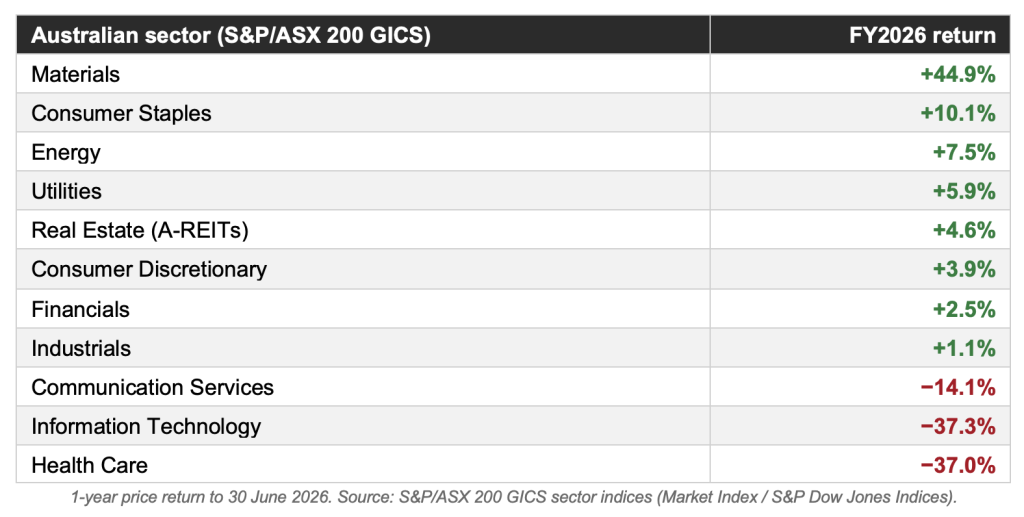
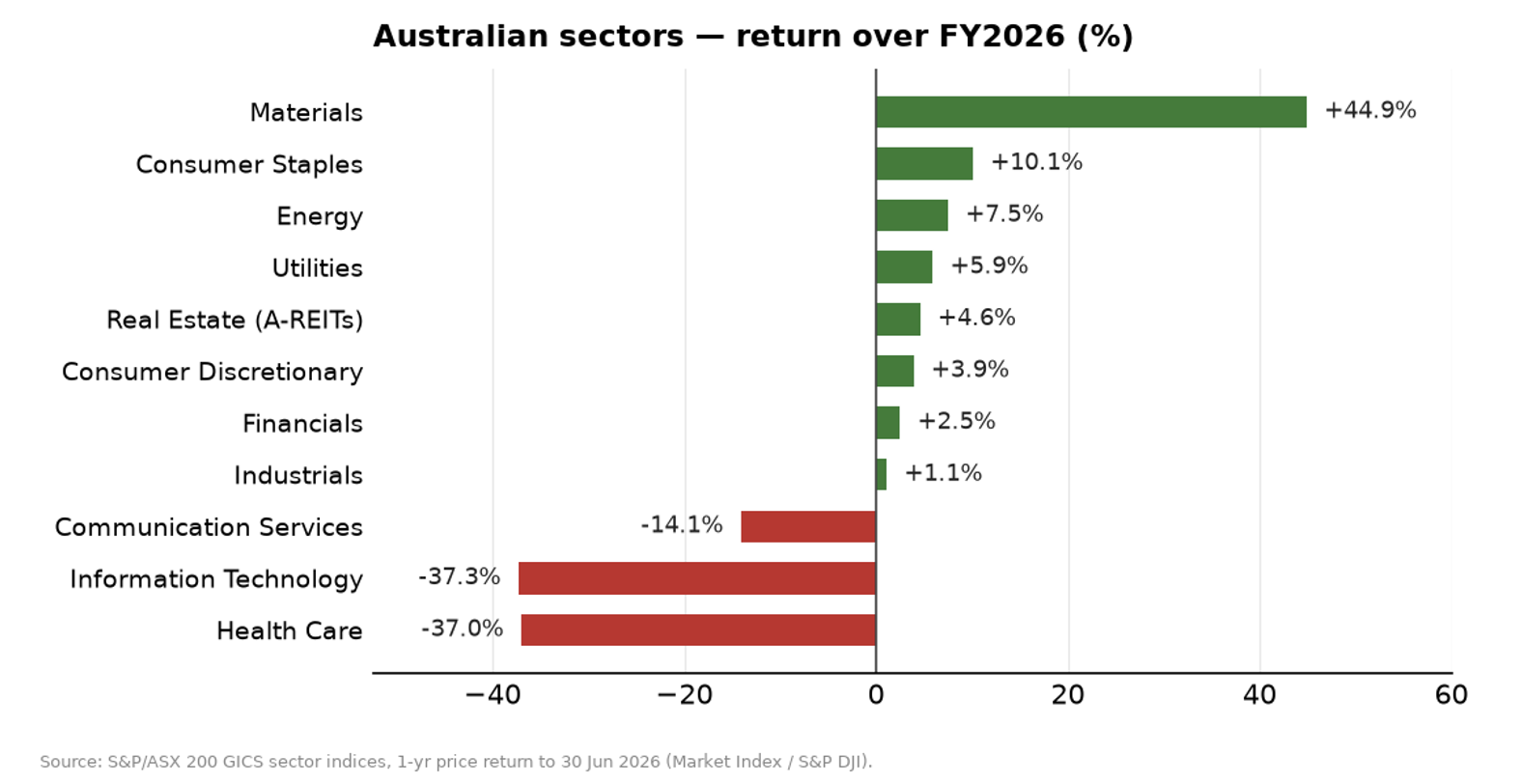
- A wide gap under the surface. The best sector (Materials) and the worst (Health Care) were more than 80 percentage points apart — the widest split in years.
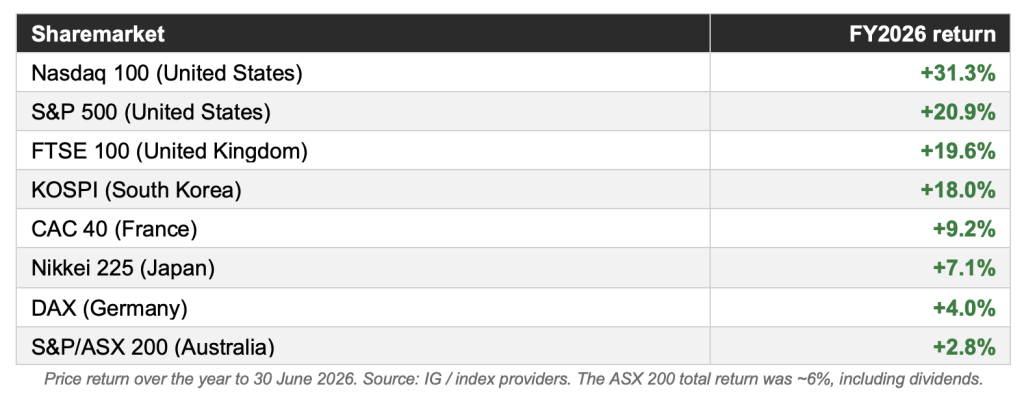
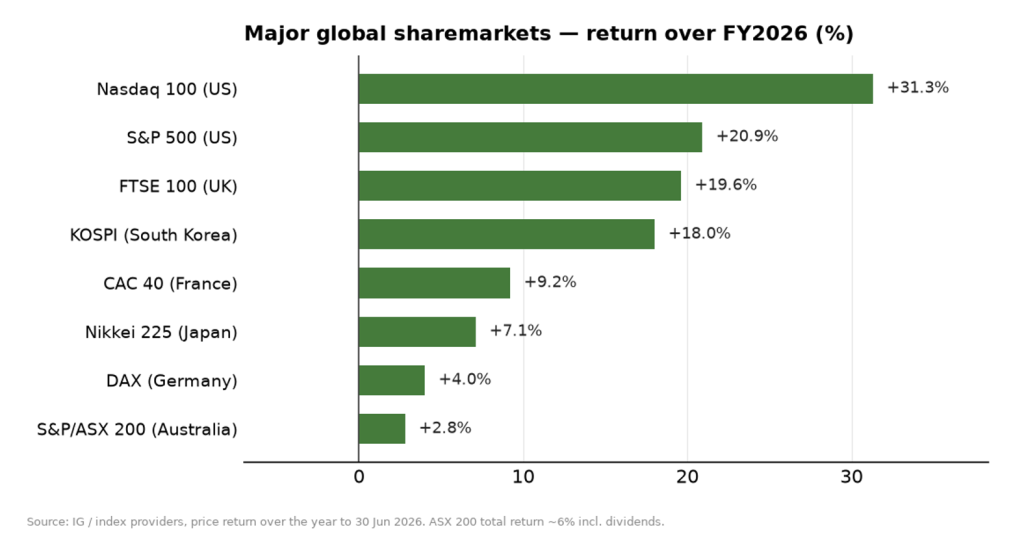
- Well behind the world. A ~2.8% price return compared with double-digit gains across much of the US, UK, Europe and Asia.
A Year of Two Halves
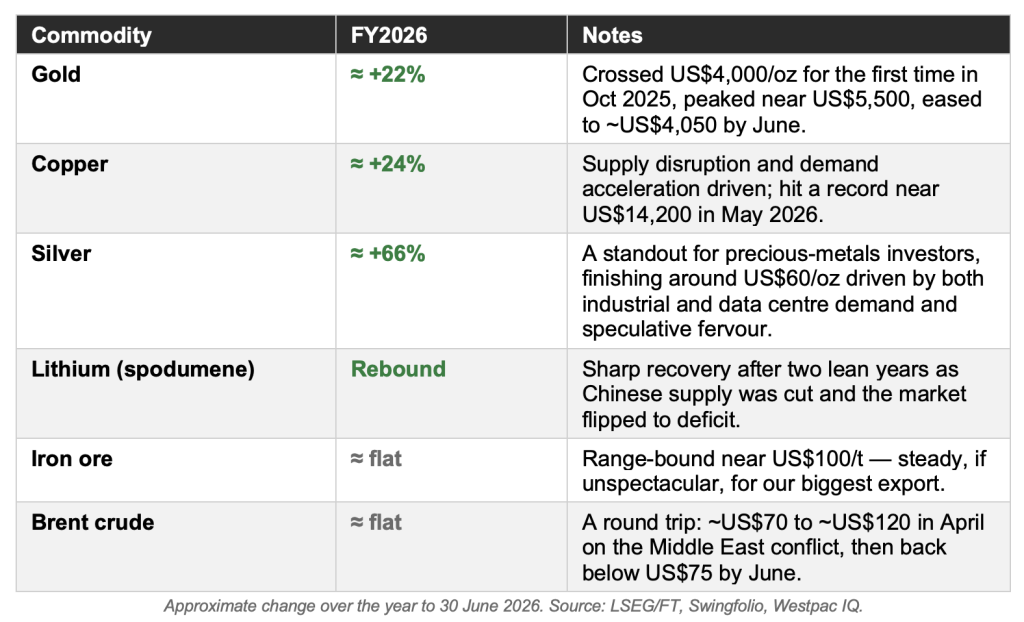
The flat headline number sat on top of anything but a calm year. The first half was a mining rally fuelled by rate-cut hopes, carrying the index to its February record. The second half told a very different story: conflict flared in the Middle East, oil ran from around US$70 to roughly US$120 a barrel by April, inflation picked back up, and the Reserve Bank switched from cutting rates to raising them. By 30 June — with oil back below US$75 after a US–Iran agreement in mid-June — the index had settled well below its highs. In short: money left the expensive, long-duration names and rotated hard into resources.
Australian Sectors
This was a resources year, plain and simple. Materials led the market by a wide margin, powered by gold, copper and a lithium revival, while the more expensive corners — technology and healthcare experienced material sell-offs.The former was mainly driven by concerns around AI disruption to business models and profitability, while the healthcare sector was impacted by idiosyncratic company drivers, most notably the market’s delayed appreciation for rising competition for CSL across a range of its products.
Global Markets
The gap between our market and the rest of the world came down largely to one word: technology. US and Asian markets were carried by the artificial-intelligence theme — a theme the Australian market has very little direct exposure to, with technology only 2–3% of the ASX 200 versus around 30% of the S&P 500.
The Australian Dollar
The Australian dollar had a solid year, driven as much by a weaker US dollar as by anything happening at home. It started the financial year around US$0.65, strengthened through the second half of 2025 and into 2026, and touched a high above US$0.72 in May before easing back to finish near US$0.69 — a gain of roughly 5% for the year.
Two forces did most of the work. A softer US dollar driven by debasement concerns and anti-America narratives lifted the Aussie for much of the year, while the Reserve Bank’s shift to raising interest rates late in the year lent further support. Pulling the other way were softer commodity prices into June and safe-haven demand for the US dollar during the Middle East conflict. On a trade-weighted basis — measured against a basket of our major trading partners’ currencies — the dollar finished the year around 64.6. For investors, a stronger Aussie is a mild headwind for unhedged overseas holdings and for our exporters, but a help for anyone buying goods, services or travel priced in US dollars.
Commodities
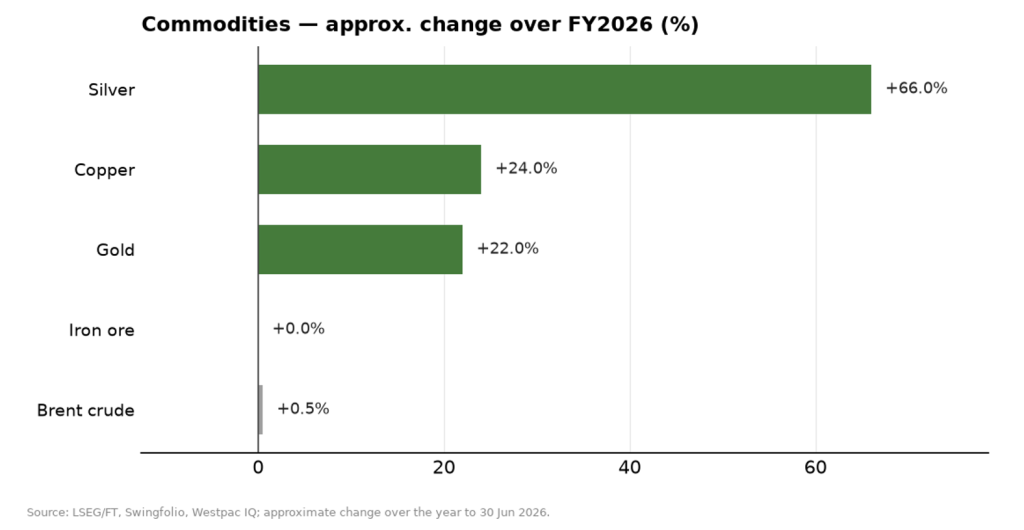
Commodities told two stories. Precious and base metals were the engines of the year, while the bulk commodities and energy that Australia is best known for were comparatively subdued.
The Year’s Biggest Movers
The winners were clustered tightly in mining and critical minerals; the losers were the market’s former darlings, re-pricing as interest rates rose.
Winners — the miners came back. BHP +62%, Rio Tinto +61%, Newmont +54% and Evolution Mining +51% rode gold and copper higher, while lithium roared back with Pilbara Minerals +276% and Mineral Resources +188%. The single biggest mover in the whole index was respiratory-imaging group 4DMedical, up around 1,749%.
Losers — the darlings broke. WiseTech Global −70% (amid a governance saga), Tuas −61%, Xero −60%, Cochlear −59% and, most notably, CSL −52% — long the bluest of blue chips — after it cut profit guidance. Quality businesses, but ones that had been priced for perfection.
Valuations, Earnings & Rates
After a year of rotation, valuations look healthier than they did twelve months ago. The market’s most stretched growth names have come well off their highs, while resources re-rated on stronger commodity earnings. The ASX 200 still trades on a forward price-to-earnings ratio a little above its long-run average, but the excesses at the top of the market have largely unwound – not sure I agree with this massive excess valuations in banks and some other areas in ASX. The Reserve Bank ended the year with the cash rate at 4.35%, having raised three times before pausing in June, with underlying inflation still around 3.6%. Higher rates are a headwind for shares, but they also mean cash and fixed income are finally paying a meaningful return again.
Looking Ahead to FY2027
A new financial year brings a cleaner slate. The big questions are familiar ones: will inflation cool enough for the Reserve Bank to stop raising rates, will the global AI boom broaden out or fade, and can our resources sector keep its momentum? After a year where patience was tested and the gains were narrow, the lesson is an old one — stay diversified, keep a long-term focus, and don’t chase last year’s winners. If you’d like to talk through what any of this means for your portfolio, we’re only a phone call or a short drive away.